
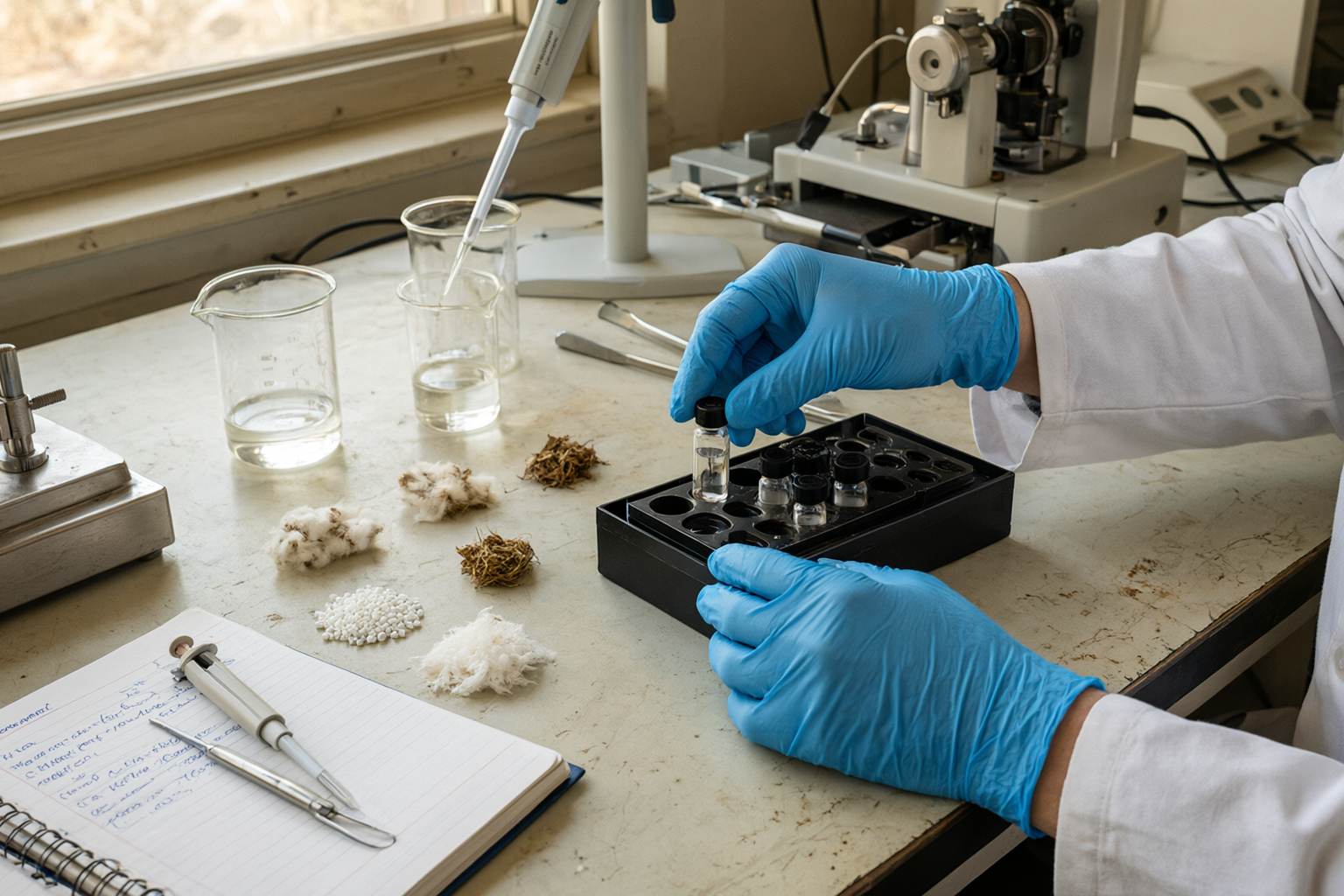
In our companion article on garlic oil fraud, we mention carbon-14 testing as the definitive way to expose synthetic material sold as natural. But what is carbon-14, exactly? How does a particle from deep space end up inside a garlic bulb — and how does a laboratory turn that physics into a certificate that stands up in an audit?
This article walks the whole chain: the cosmic-ray reaction that manufactures 14C in the atmosphere, the biology that carries it into plants, the radioactive clock that starts ticking when carbon is fixed, the two families of instruments that count it, and finally how that science lands on your desk as a pass-or-fail result for a drum of garlic oil.
Born in the Upper Atmosphere: How Cosmic Rays Make Carbon-14
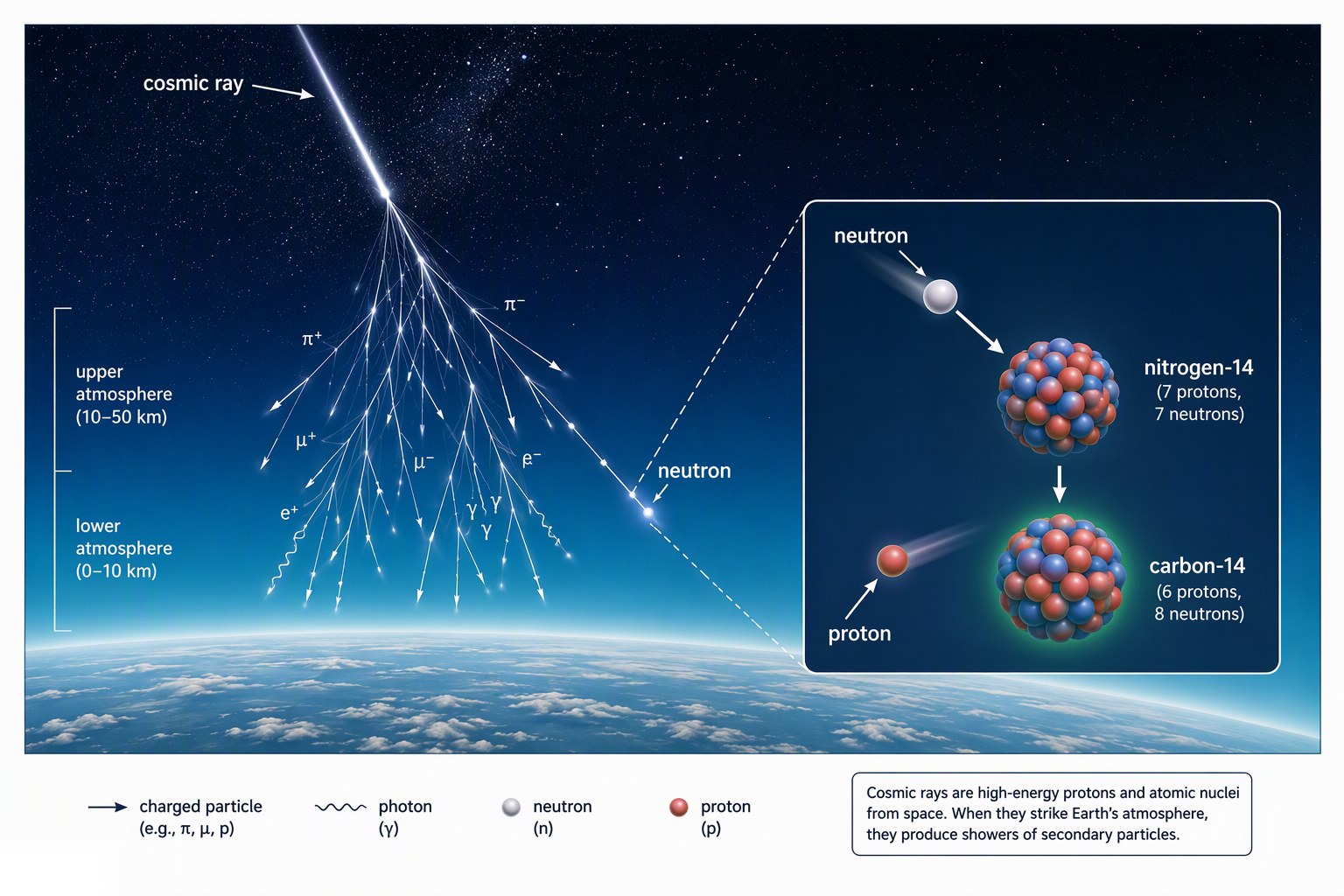
Carbon-14 does not come from the Earth. It is manufactured continuously, about 15 to 20 kilometers above our heads, by the most energetic particles in the galaxy.
Primary cosmic rays — mostly high-energy protons accelerated by supernova shock waves — slam into the upper atmosphere at nearly the speed of light. The first collision shatters air molecules and triggers an air shower: a cascade of secondary particles, including a hail of free neutrons. Those neutrons are the key. When a secondary neutron strikes an ordinary nitrogen-14 nucleus, the nucleus ejects a proton and becomes carbon-14:
¹⁴N + n → ¹⁴C + p
That single nuclear reaction — neutron capture by nitrogen, with proton emission — produces essentially all of the 14C on Earth, at a rate of roughly two atoms per square centimeter of surface every second. Within weeks, each new 14C atom oxidizes to 14CO₂ and mixes into the global atmosphere.
From Thin Air to Garlic Bulbs: How ¹⁴C Enters the Food Chain
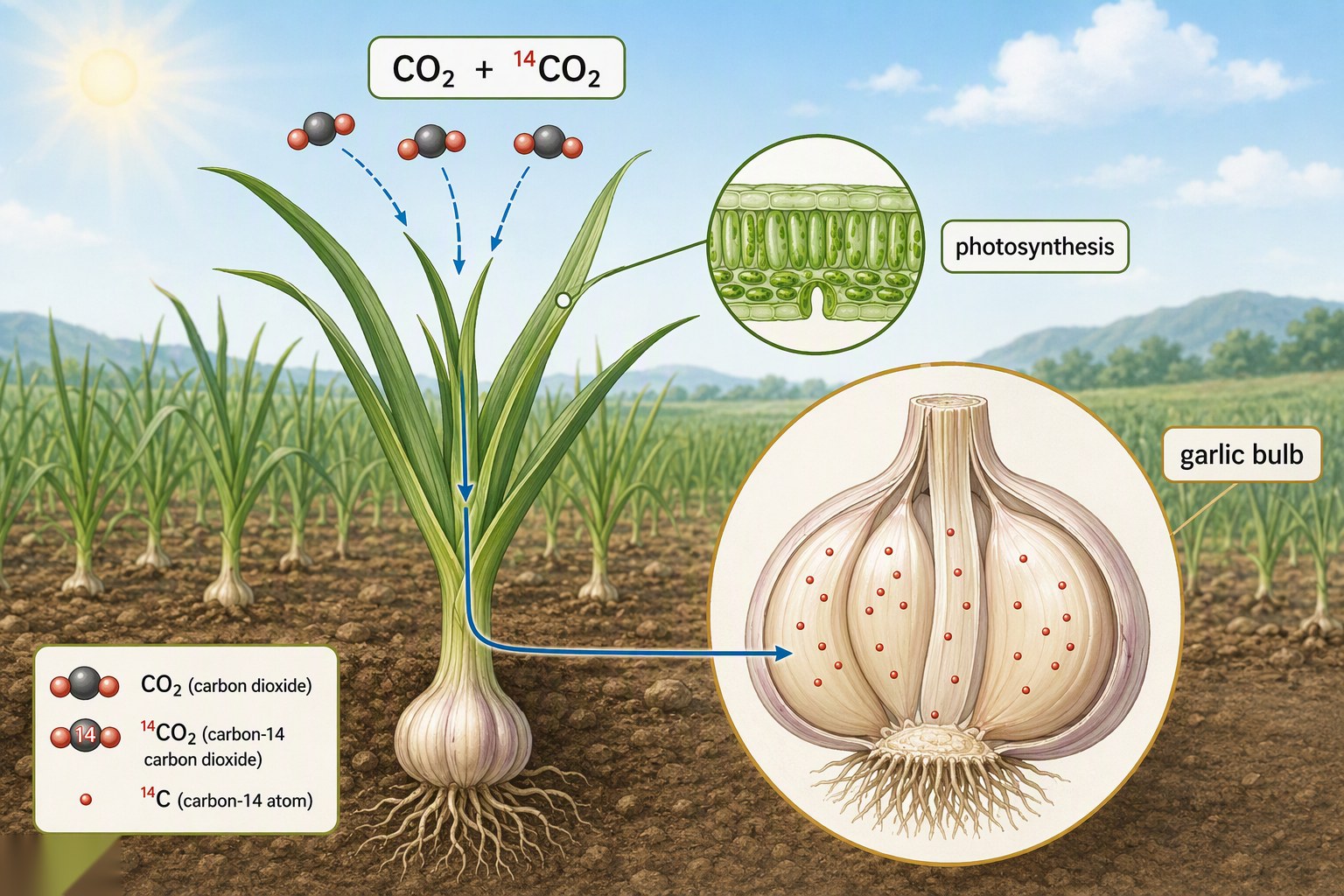
Photosynthesis does not discriminate. A garlic leaf absorbs a 14CO₂ molecule exactly as readily as an ordinary 12CO₂ molecule, and the carbon becomes sugar, cellulose, and eventually the sulfur-rich essential oil stored in the bulb. Every living plant — garlic, vanilla, citrus, soy — keeps its tissue carbon in equilibrium with the atmosphere. Herbivores eat plants, we eat both, and the whole biosphere shares approximately the same 14C concentration.
Scientists express that concentration as percent modern carbon (pMC), where "modern" is defined by an internationally agreed reference. Fresh plant material today reads close to 100 pMC. (Atmospheric nuclear testing in the 1960s briefly doubled 14C levels; the excess has been decaying and diluting ever since, which is why very recent crops can read a few percent above 100 — a well-understood calibration detail for testing labs.)
The important number for buyers is this: anything that was recently alive carries roughly 100 pMC of carbon-14. And anything that was not?
The Decay Clock: 5,730 Years of Ticking
Carbon-14 is unstable. It decays by beta emission, converting a neutron back into a proton and turning itself into nitrogen-14:
¹⁴C → ¹⁴N + e⁻ + ν̄ (half-life ≈ 5,730 years)
The emitted electron (beta particle) is weak — at most 156 keV, easily stopped by a sheet of paper — which is precisely why 14C dating works over archaeological timescales but also why counting those betas requires sensitive instruments.
Here is the part that matters for ingredient authentication. Once carbon is fixed into plant tissue, no new 14C arrives, and the clock runs. In 5,730 years, half is gone; in about 50,000 years, effectively all of it. Petroleum formed from organisms buried millions of years ago has long since dropped to zero pMC. Synthetic aroma chemicals built today from petrochemical feedstocks are assembled entirely from that ancient, 14C-free carbon.
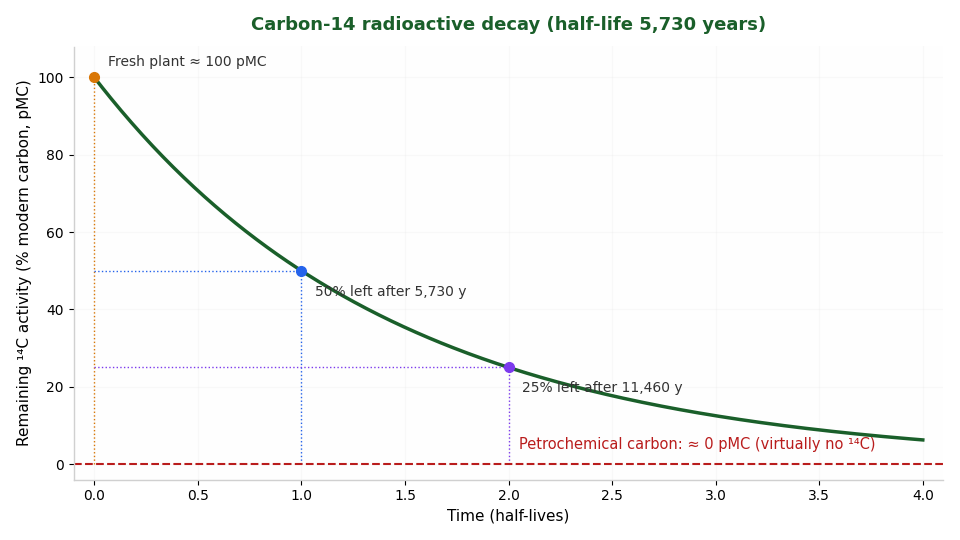
And that asymmetry is the entire trick: a laboratory does not need to identify which molecules are in the oil. It only needs to count how much 14C the carbon carries. Plant-grown carbon answers near 100. Fossil-fed carbon answers near zero. No synthetic chemistry can disguise that label.
How Laboratories Actually Measure It: Two Instruments
Method 1 — Liquid Scintillation Counting (LSC): Counting the Flashes
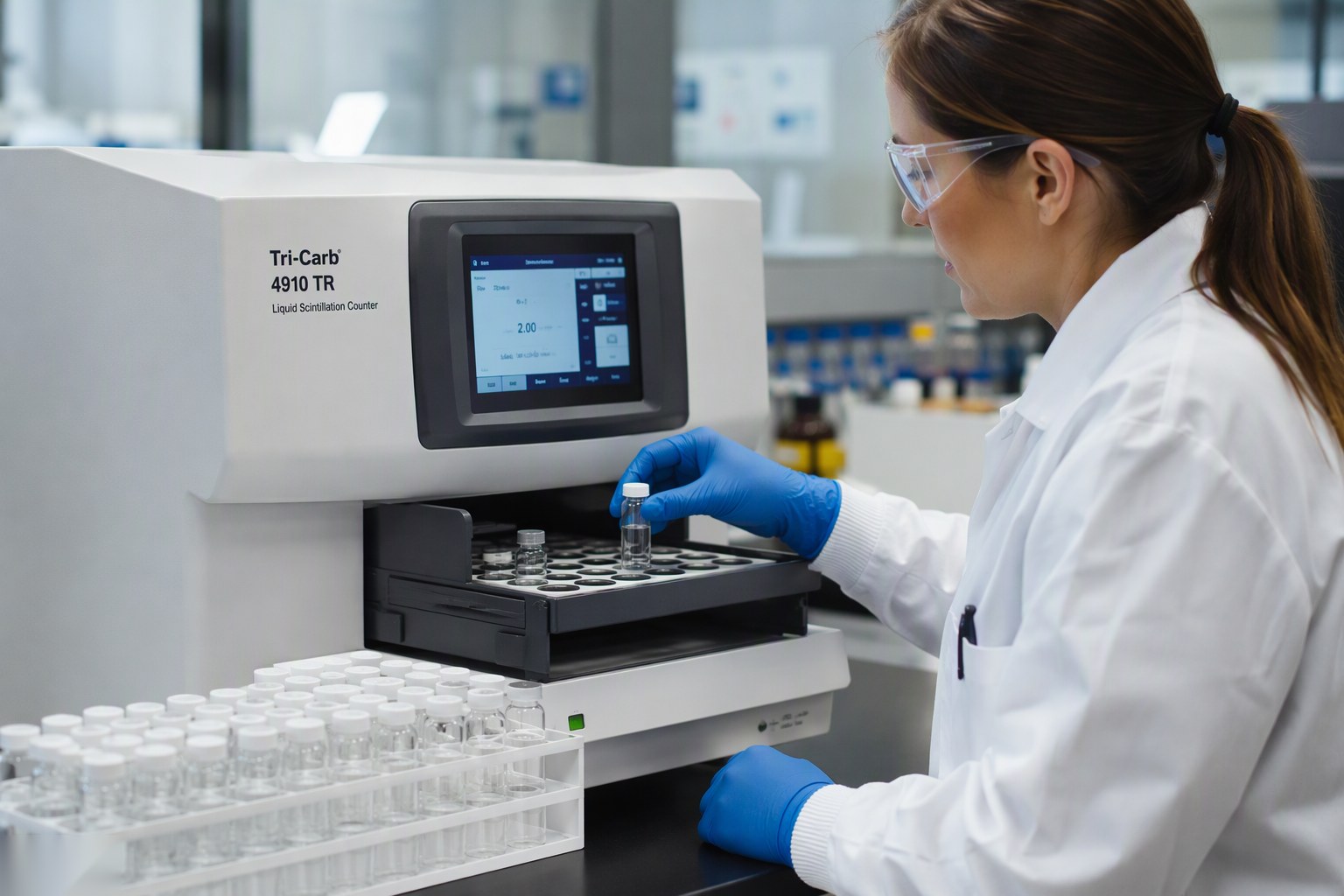
The classical method, still widely used, detects the beta particle itself. The lab combusts the sample to CO₂, purifies it, and chemically synthesizes benzene (C₆H₆) — chosen because each molecule carries six carbon atoms and it dissolves scintillator dyes beautifully. The benzene is mixed with a fluorescent cocktail in a glass vial and placed inside a liquid scintillation counter, a light-tight instrument lined with photomultiplier tubes.
Each 14C decay deposits its tiny energy in the cocktail, which answers with a flash of visible light. The counter tallies flashes over days to weeks and converts the rate into pMC. LSC is mature, comparatively affordable, and routine — but it needs grams of carbon and long counting times to push precision below ±0.5 pMC.
Method 2 — Accelerator Mass Spectrometry (AMS): Counting the Atoms
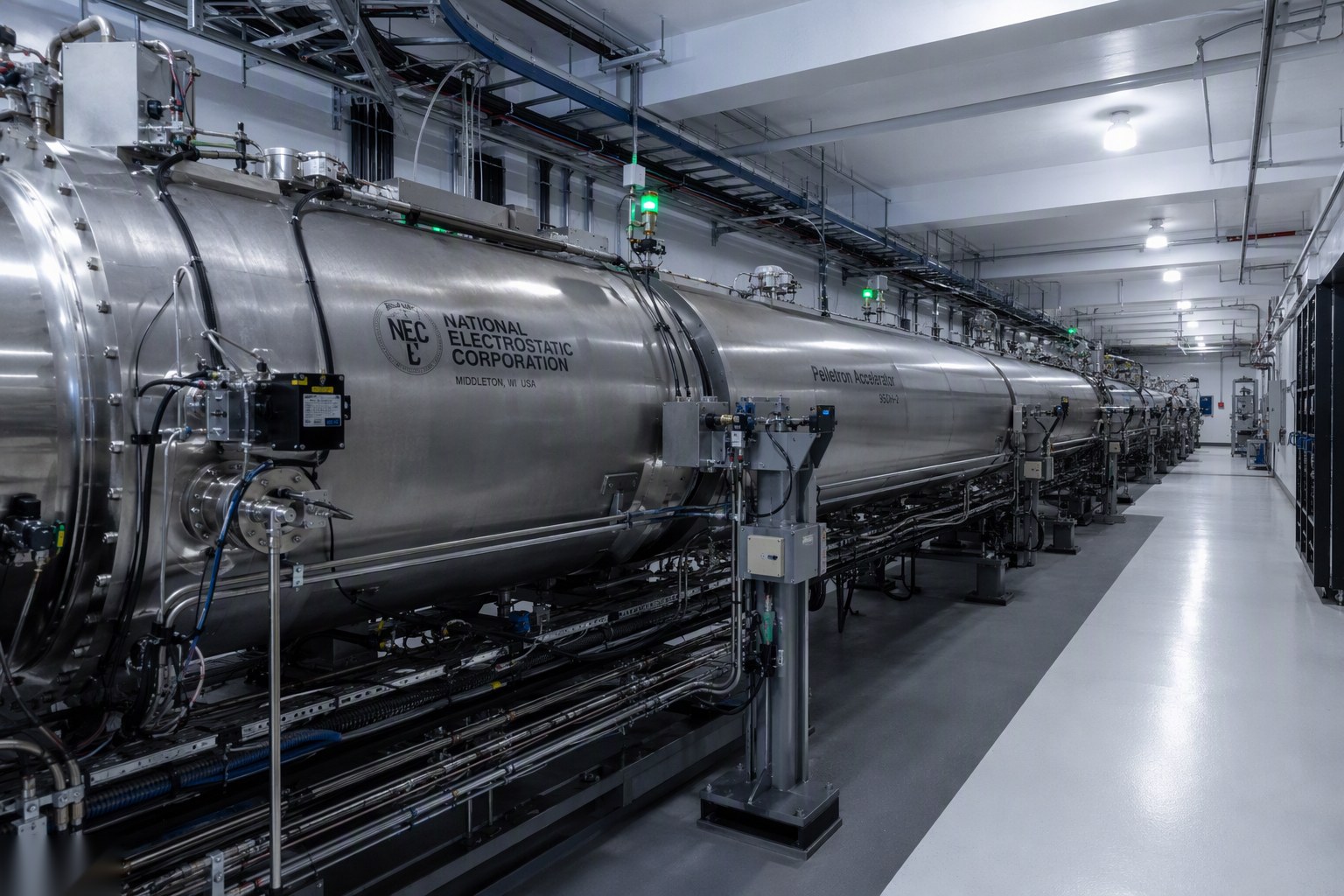
The modern workhorse for food authentication counts 14C atoms directly, rather than waiting for them to decay. AMS needs only milligrams of carbon — a few drops of oil — and returns results in minutes of beam time.
The pipeline: the sample is combusted to CO₂ and reduced to a pinhead of graphite, pressed into a target holder. Inside the ion source, cesium ions bombard the graphite, sputtering off negative carbon ions (C⁻) — an elegant trick, because negative molecular ions like ¹³CH⁻ and ¹²CH₂⁻ mimic 14C's mass but are destroyed at the next stage. The ions accelerate toward the positive terminal of a tandem accelerator, pass through a thin foil or gas that strips several electrons away, breaking every interfering molecule apart, then accelerate again away from the terminal. Magnetic and electrostatic filters separate ¹²C, ¹³C, and ¹⁴C by mass and energy, and fast detectors count the rare 14C ions one by one.
Because AMS measures isotope ratios against the stable isotopes 12C and 13C in the same run, it is both extraordinarily sensitive and internally calibrated — precision of ±0.1 to ±0.3 pMC is routine.
Results are reported in pMC — and for biobased-content claims, that maps directly onto standards such as ASTM D6866 and ISO 16620-2, which is why an AMS certificate reads cleanly in regulatory files and retailer audits.
The Garlic Oil Payoff: Catching Fossil Carbon in a "Natural" Drum
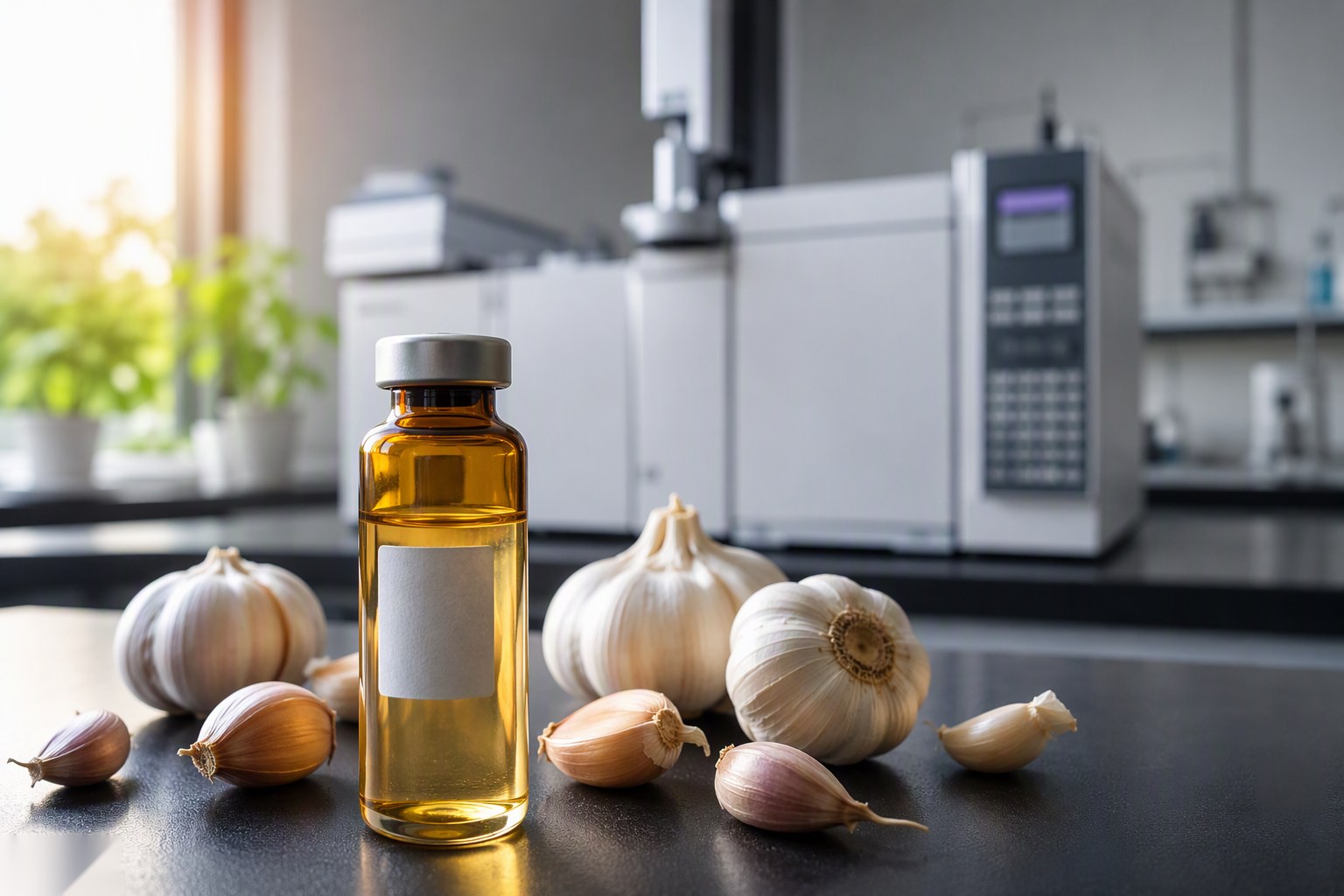
Return to garlic oil. GC-MS maps the oil's molecule-by-molecule fingerprint, and it is excellent at that job — but synthetic diallyl disulfide is chemically identical to the plant's own. A sophisticated adulterator can pass a GC-MS screen with a well-built blend. This is where carbon-14 is uncheatable.
Natural garlic oil is distilled from recently harvested bulbs: every carbon atom is plant-fixed, and the whole oil reads near 100 pMC. Synthetic garlic flavor is built from propylene or other petrochemical precursors: its carbon is millions of years old and reads essentially 0 pMC. A 50/50 blend reads near 50. The measurement tolerates no argument, because no reaction vessel can put cosmic-ray carbon back into fossil feedstock.
This is why leading authentication laboratories report that nearly one in three "natural" ingredient samples they test shows complete or partial petrochemical derivation — and why buyers who demand 14C certificates catch adulterated drums before they reach a production line, not after a recall.
One honest caveat: 14C answers the origin of the carbon, not the identity of the molecules. Blending expensive garlic oil with cheap vegetable oil — modern carbon diluting modern carbon — barely moves the pMC number; GC-MS catches that. And stable-isotope ratios (δ¹³C) add a third, complementary fingerprint. Serious programs use all three; carbon-14 is simply the one a cheater cannot synthesize away.
The Bottom Line
Carbon-14 is a thread connecting supernova debris to a garlic field to a laboratory certificate. Cosmic rays manufacture it in the sky, plants capture it from the air, its 5,730-year decay clock separates yesterday's harvest from ancient petroleum, and liquid scintillation counters or AMS instruments read the answer in pMC. For buyers of natural ingredients, that number — plant carbon near 100, fossil carbon near zero — is the single most forgery-proof quality check in the toolkit.
Ask for it by name: a current carbon-14 (AMS) certificate, reported in pMC, alongside the GC-MS chromatogram. Suppliers of genuinely natural material provide both without hesitation.
Frequently Asked Questions
How much sample does a lab need for carbon-14 testing?
With AMS, only a few milligrams of carbon — a few drops of oil — are enough for a precise pMC result. Classical liquid scintillation counting requires grams of material, because it must wait for enough atoms to decay on their own.
How long does carbon-14 testing take?
AMS laboratories typically report within about two weeks including chemistry and calibration; high-throughput labs can be faster. LSC campaigns run longer because each vial may count for days to weeks.
What pMC value proves an ingredient is 100% natural?
Freshly grown plant material reads around 99–103 pMC (the slight variation reflects the decaying excess from 1960s nuclear tests). A result consistent with 100 pMC supports a fully plant-derived claim; values near zero indicate fossil carbon; anything in between signals a blend.
Can a supplier cheat a carbon-14 test?
Practically no. The only way to raise fossil carbon toward 100 pMC would be dosing the sample with bomb-pulse material or modern carbon — detectable, expensive, and commercially absurd. Unlike GC-MS fingerprints, the 14C signal cannot be mimicked by synthetic chemistry.
Does garlic oil from different growing regions read differently in 14C?
No meaningful difference — atmospheric 14CO₂ mixes globally on a timescale of years, so garlic from any growing region reads essentially the same pMC. Regional origin questions are answered by stable isotopes (δ¹³C, δ²H) and trace-element profiles instead.
How is carbon-14 testing different from carbon-13 (stable isotope) testing?
δ¹³C measures the ratio of two stable carbon isotopes and fingerprints a plant's photosynthetic pathway (C3 vs C4) and geography. Carbon-14 measures radioactive decay and fingerprints carbon age — living biosphere versus fossil deposits. The two tests are complementary and are strongest when run together.