
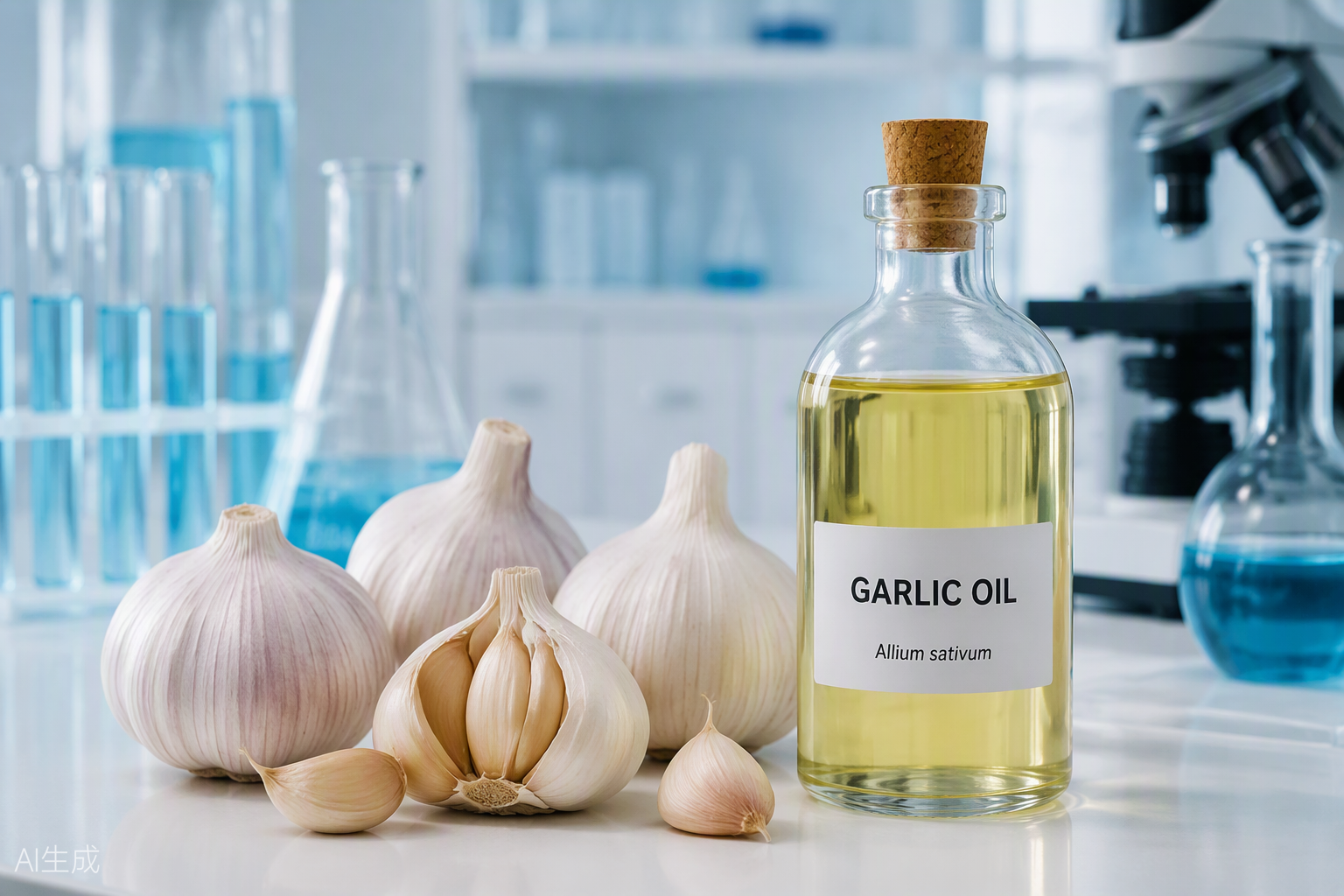
The Clean-Label Imperative
Walk down any supermarket aisle and the shift is visible: ingredient lists are getting shorter, and names that sound like chemistry homework are disappearing. Potassium sorbate, sodium benzoate, calcium propionate — workhorse preservatives for half a century — are being reformulated out of sauces, dressings, dips, and prepared meals.
This is not a fad. Retailers in North America, Europe, and East Asia now maintain "no-no lists" for their private labels, and consumers increasingly read back-of-pack before front-of-pack. For formulators, the question is no longer whether to find natural alternatives, but which natural alternative actually works.
How Garlic Oil Works as a Preservative
Garlic's antimicrobial power comes primarily from allicin and its related organosulfur compounds — diallyl disulfide, diallyl trisulfide, and ajoene. These compounds disrupt microbial cell membranes and interfere with sulfur-dependent enzymes that bacteria and yeasts need to reproduce.
The spectrum is genuinely broad: studies document activity against E. coli, Salmonella, Listeria monocytogenes, Staphylococcus aureus, as well as common spoilage yeasts and molds. That range matters, because most natural antimicrobials are narrow — effective against bacteria but not fungi, or vice versa.
Steam-distilled garlic oil concentrates these sulfur compounds dramatically. Where fresh garlic contains roughly 0.3–0.5% volatile oil, the distilled oil is essentially pure active fraction — which is why effective dosing is measured in parts per million, not percent.
Application Guidelines
Typical use rates. For sauces, dressings, and emulsions, formulators typically start at 50–200 ppm of garlic oil, adjusted for the product's water activity, pH, and fat content. Oil-in-water emulsions are favorable territory: the oil phase carries the garlic oil, and the antimicrobial concentrates at the oil-water interface where microbes prefer to grow.
Flavor management. The obvious objection is taste. At preservative-effective levels, a well-standardized garlic oil reads as "savory depth" rather than "garlic bread" — but this depends on dose, matrix, and oil quality. In products where garlic notes are welcome (marinades, hummus, pasta sauces, plant-based meats), it is a genuine dual-purpose ingredient: flavor plus preservation.
Stability. Organosulfur compounds are heat-sensitive. Add garlic oil late in the process where possible, or validate that your thermal step leaves sufficient residual activity. Challenge testing with your actual formulation is not optional — it is the only way to set a defensible shelf life.
Regulatory Considerations
Garlic oil is broadly accepted as a food ingredient (flavoring) in major markets, and that status is precisely its appeal: "garlic oil" on an ingredient list is consumer-friendly in a way "potassium sorbate" no longer is. However, preservation claims are regulated differently by jurisdiction. In most markets, you may formulate with garlic oil as a flavoring while benefiting from its antimicrobial function — but you cannot label it as a "preservative" without the corresponding additive approval.
Work with your regulatory team on three points: the additive-versus-flavoring classification in your target market, maximum use levels where they exist, and allergen labeling rules. Garlic is not a major declared allergen in the US or EU, but documentation expectations differ.
What to Ask Your Supplier
Not all garlic oils perform alike. Before qualifying a source, request: a GC-MS profile showing diallyl disulfide and trisulfide content, a Certificate of Analysis for the specific lot, microbiological specifications, and a statement on carriers or dilution. An oil cut with a neutral carrier will underperform at the same nominal dose — and your challenge test will catch it only after you've lost a development cycle.
Consistent allicin-potential, batch after batch, is what turns a promising bench trial into a scalable product. That consistency is a sourcing question as much as a chemistry question.