
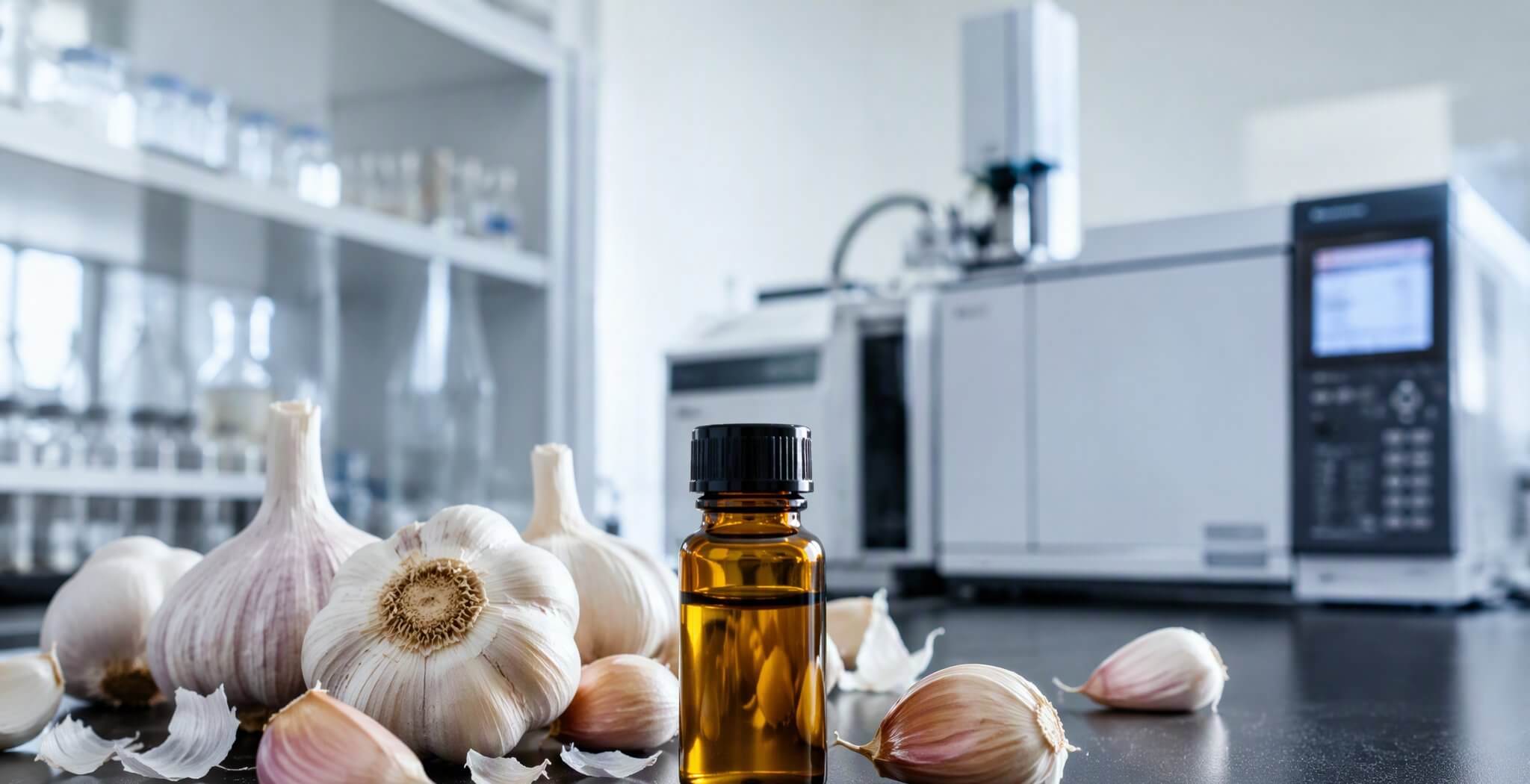
“We regret to inform you that all four sets of samples have been rejected — allyl chloride was detected during our analysis.”
This is a real rejection letter, and it lands on procurement managers who are not organic chemists like a message from another planet. What is allyl chloride? Why is it in the oil? Is it a pesticide residue? A plasticizer? Or did the laboratory simply get it wrong?
In our companion article, “Carbon-14 Testing: From Cosmic Rays to Proving Natural Origin,” we explained how radiocarbon exposes petrochemical material sold as natural. But one question was left open: GC-MS compares molecular fingerprints, and synthetic diallyl disulfide is chemically identical to the plant’s own — a skilled adulterer can blend a chromatogram that passes the screen. So how do laboratories still catch it, every time? The answer is a compound that has no business existing inside any plant.
What Is Allyl Chloride?
Allyl chloride (3-chloropropene, CAS 107-05-1) is a colorless liquid that boils at just 45 °C. Industrially it is a workhorse intermediate and solvent, produced in the millions of tons for epoxy resins, pesticides, and flavor chemicals.
Buyers only need to remember two things. First, it sits on no regulator’s list of acceptable impurities — quite the opposite: it is treated as a suspected genotoxic impurity, on the ICH M7 structural-alert list, and European and American buyers apply zero tolerance: detected, therefore rejected. Second, no compliant natural extraction process can plausibly introduce it into a botanical essential oil. That is the key to the whole story.
Why Genuine Garlic Oil Never Contains It
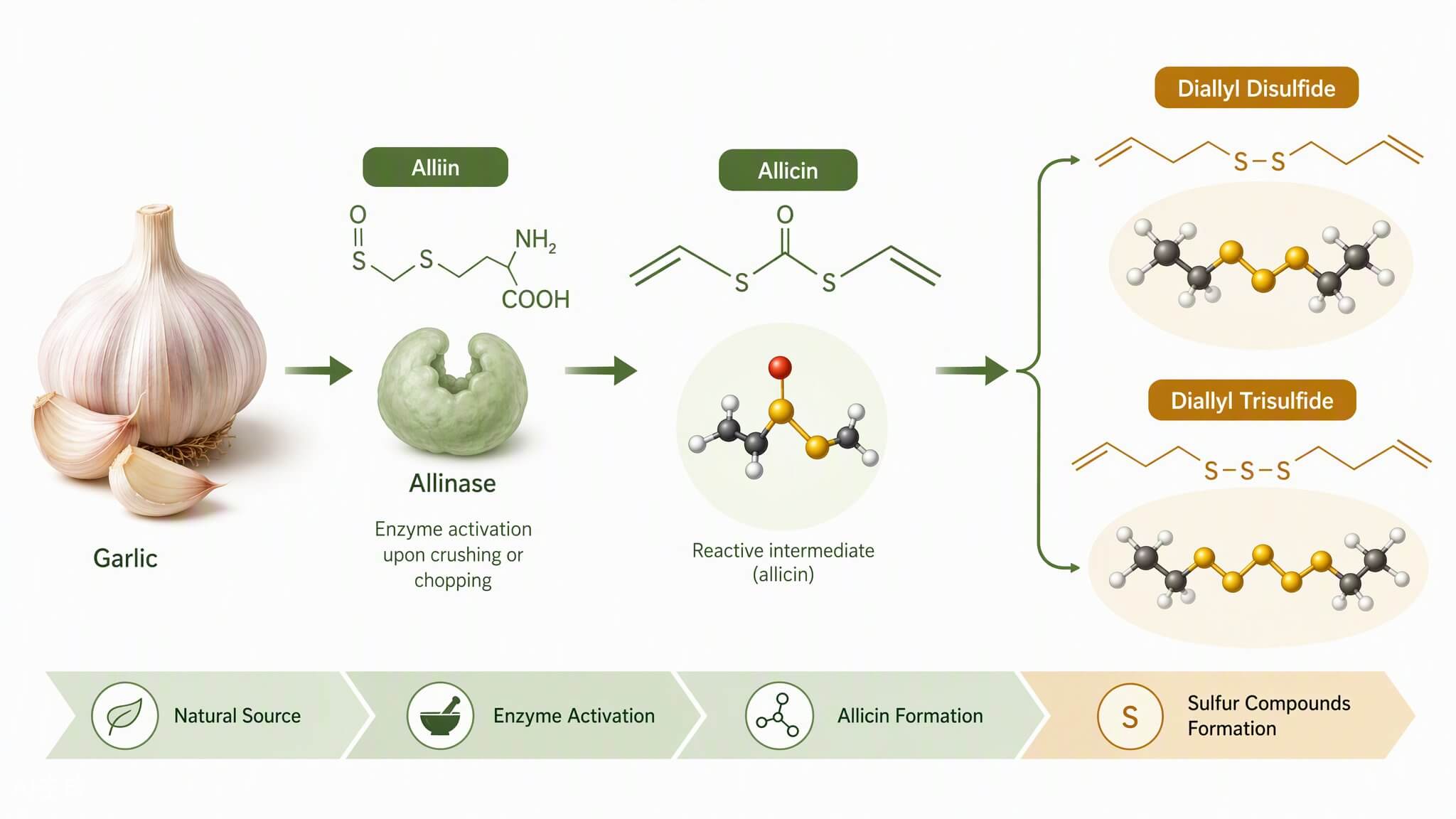
The signature flavor of garlic oil comes from sulfur compounds — diallyl sulfide, diallyl disulfide, diallyl trisulfide. Their birth is well understood: in an intact clove, alliin and the enzyme alliinase are kept apart in different cells; once tissue is crushed, they meet, and the enzymatic cascade produces allicin, which rearranges into the stable diallyl polysulfides.
Look at every link of that biosynthetic chain: the inputs are amino acids, the catalysts are enzymes, and chlorine never enters at any step. Steam distillation is a physical separation of volatiles already present in the clove — it cannot conjure a chlorinated organic molecule out of nothing. In other words, in genuinely distilled garlic oil, the expected level of allyl chloride is zero. That is not a harsh specification; it is chemistry.
Where It Comes From: The Synthetic Route’s Raw-Material Fingerprint
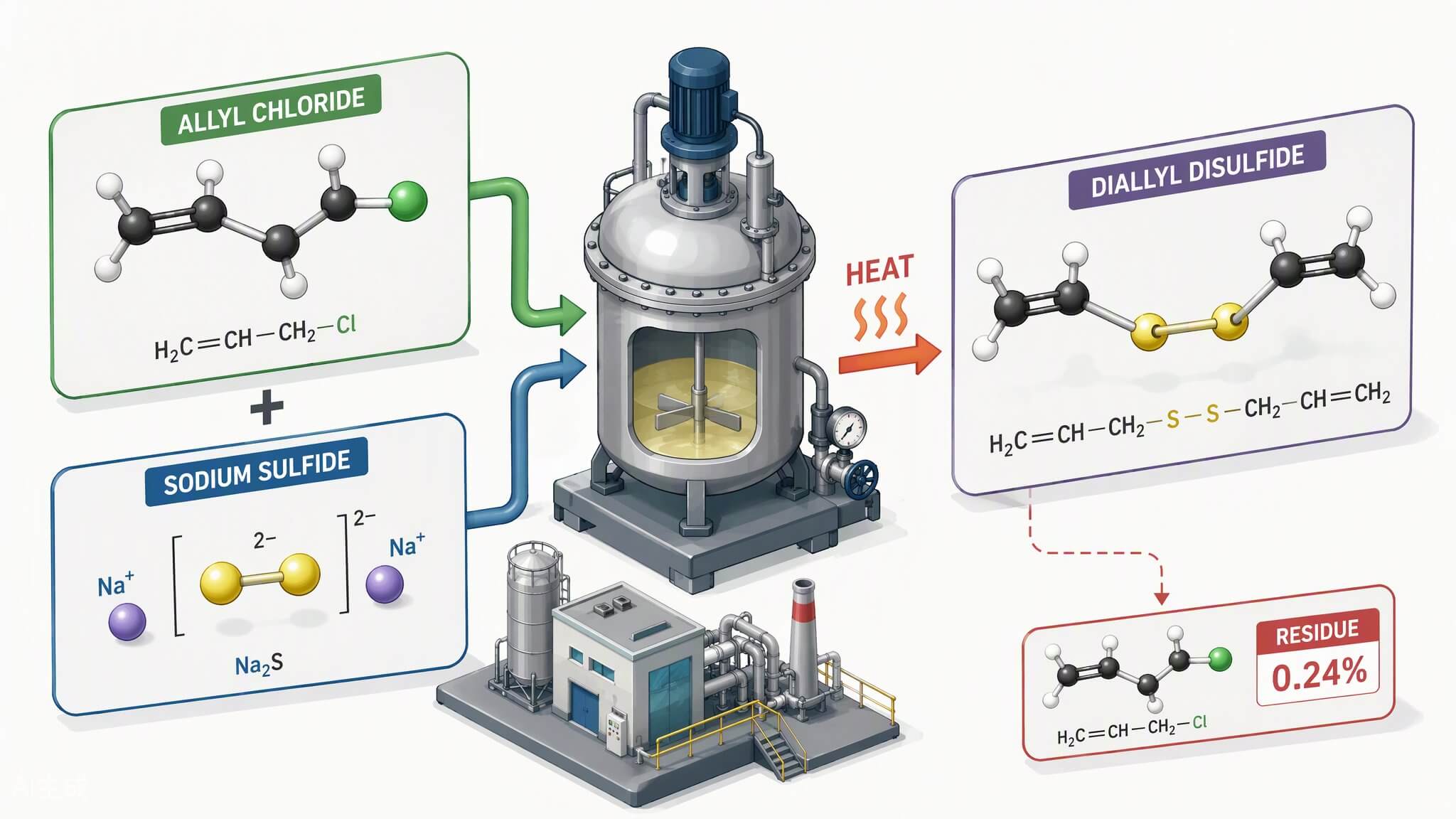
So where does the detected allyl chloride come from? The answer lies on the production floor of synthetic garlic flavor. The classic industrial route to diallyl disulfide uses allyl chloride as the raw material, reacted with sodium sulfide under heat in an inert atmosphere. To drive the reaction, factories charge allyl chloride in excess — and because the raw material is low-boiling and volatile, no downstream step removes it completely.
Published research compared GC-MS spectra of natural garlic oil and synthetic garlic allicin: the synthetic product consistently showed roughly 0.24% chloropropene residue, while the natural oil showed none — a finding researchers turned into an explicit adulteration criterion. The logic is airtight: allyl chloride is raw-material residue from synthetic production, a fingerprint only the synthetic route can leave. The natural pathway cannot create it, any more than an oil refinery can grow garlic.
Could It Be Pesticide Residue?
No. Whatever agents garlic farming may involve — organochlorines, chloropicrin soil fumigants, organophosphates — each is a complete, stable molecule. GC-MS identifies each by its own retention time and mass spectrum; a pesticide will not be misreported as allyl chloride, and stable pesticide molecules will not degrade “into” allyl chloride under steam distillation. These are two different questions, with two different test panels.
Could It Be Plasticizer Contamination?
No either. Phthalate plasticizers (DEHP, DBP) contain no chlorine at all. Plasticizer contamination typically comes from non-compliant plastic drums, hoses, and gaskets — and what it detects as is the plasticizer itself, not a chlorinated hydrocarbon.
Could the Laboratory Be Wrong?
This is the only defense worth taking seriously. Allyl chloride is volatile and could, in theory, appear as a trace-level (ppm) cross-contaminant or misidentification. But the deciding factor is concentration: trace levels can be argued; the per-mille range (around 0.1%) cannot — that range matches synthetic raw-material residue exactly. And when all four sample sets test positive, accidental contamination is statistically excluded.
Case Study: What Happens After Four Sets Are Rejected
Unpack the handling of this incident and you get a five-step protocol anyone can copy. Step 1 — demand the raw data: ask for the GC-MS spectra, retention indices, and quantitative concentrations. Look at evidence, not conclusions. Step 2 — third-party retesting of retained samples: send retained material from the same lots to an independent lab using the same methodology; this decides whether you fight or cut losses. Step 3 — judge by concentration band: trace ppm levels justify investigating process contamination and packaging contact history; the per-mille level settles the adulteration question. Step 4 — audit the supply chain: even if the adulteration happened upstream, you bear the consequences — trace incoming COAs, supplier history, and any source changes. Step 5 — reship new lots: return to the table with fresh third-party reports.
Across twenty years of ingredient trade, we run this protocol before every shipment, not after every rejection letter. The industry lesson is simple: a supplier without pre-shipment testing leaves the most expensive test to the customer’s laboratory — and trust takes twenty years to earn and one email to lose.
How to Test Garlic Oil for Synthetic Adulteration
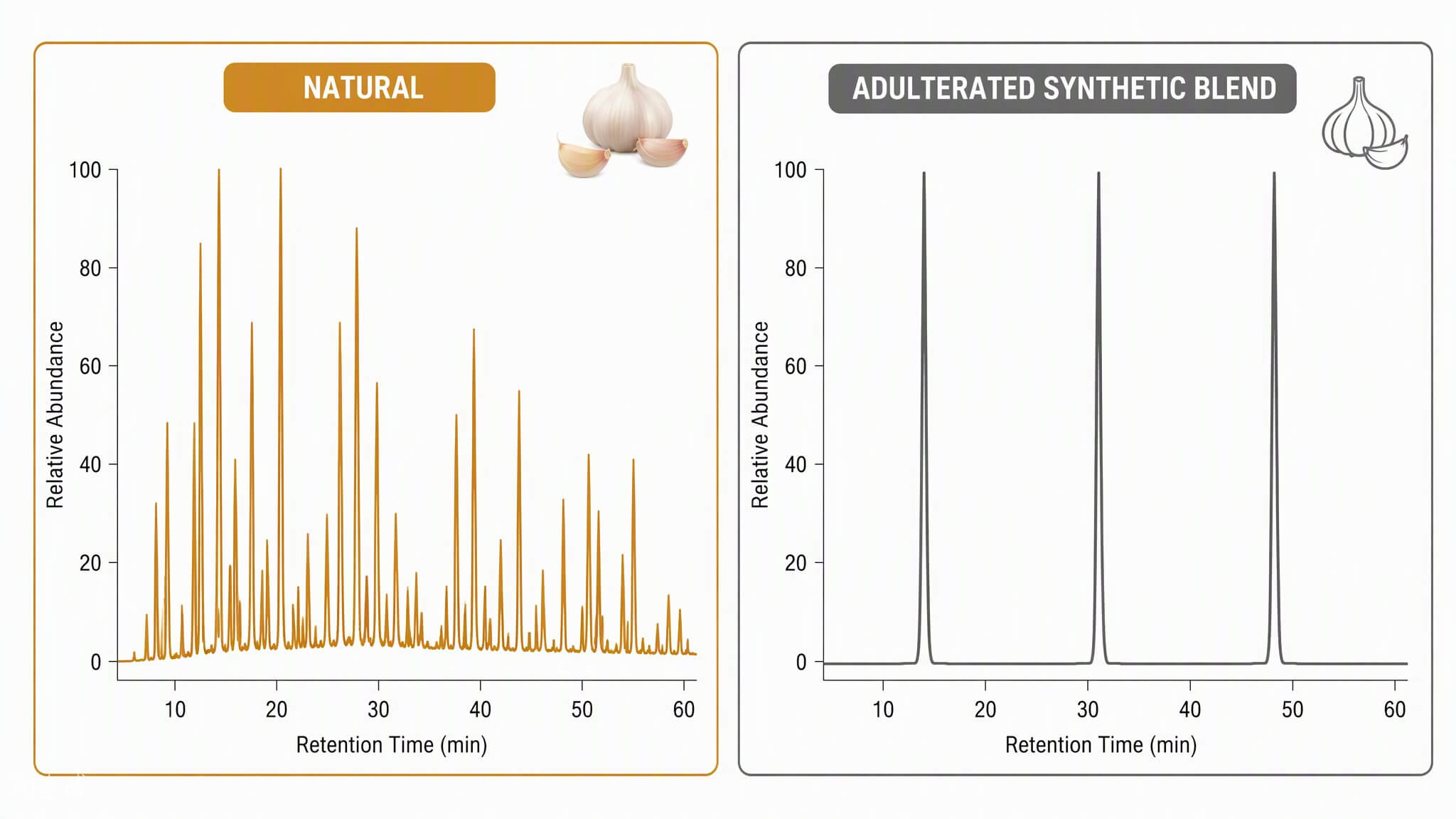
For buyers, the effective toolkit is a two-lock combination. Lock one: GC-MS compositional fingerprinting. Beyond allyl chloride itself, look at the overall chromatogram — natural garlic oil has a characteristic distribution of diallyl disulfide/trisulfide ratios and accompanying micro-components, while synthetic blends often show a few bare, isolated major peaks. Require double confirmation of suspect peaks by retention index to rule out misidentification.
Lock two: carbon-14 natural-origin verification. This is a physical yardstick no cheater can forge — synthetic flavor carbon comes from petroleum millions of years old, with radiocarbon near zero; freshly distilled plant oil reads near 100 pMC; a fifty-fifty blend reads near 50. The two methods are orthogonal: GC-MS catches the process fingerprint, carbon-14 catches the origin of the carbon. See our companion article, “Carbon-14 Testing: From Cosmic Rays to Proving Natural Origin,” for the full mechanism. The strictest programs add δ¹³C stable isotope ratios as a third fingerprint; with all three in place, no known adulteration scheme survives.
A Buyer’s Self-Protection Checklist
- Read the COA in this order: lot number first, methods second, results third — a COA without a lot number is a template, not evidence. The essentials of a credible COA are in our article “Understanding COA: What Every Buyer Should Know.”
- Retest the first commercial lot from any new supplier with an independent third party and compare it against the supplier’s COA — the testing fee is a fraction of the cargo’s value, and the difference between that fee and a full-container rejection is the difference between a checklist and a recall.
- Start small: validate the supplier’s quality system with a 1–25 kg order before discussing annual frameworks. Trust is built from accumulated data, not warm relationships.
- Ask one question — “do you test for allyl chloride?” The supplier who puts this parameter into the specification and ships the report with every lot, versus the one who changes the subject, tells you everything you need to know.
The Bottom Line
Rejection letters are expensive; knowledge is cheap. One chlorine atom, a 0.24% residue, four rejected sample sets — a true science story from the garlic oil trade. The next time a report lands on your desk with the words “allyl chloride,” you will already know what to do.
If you need pre-shipment testing built into your procurement program, or garlic oil samples with lot-numbered COAs and third-party retest reports, contact us for a quote — replies within 24 hours, MOQ from 1 kg.
Frequently Asked Questions
Can garlic oil with detected allyl chloride still be used?
No. It is evidence of adulteration and itself a suspected genotoxic impurity. Even before regulatory risk, the word “natural” on your label no longer stands.
Is allyl chloride the same as the “allyl” compounds in garlic oil?
No — but the naming coincidence is worth clearing up. Diallyl disulfide and diallyl trisulfide in garlic oil do contain an allyl structure, but they are sulfur compounds of carbon, hydrogen, and sulfur; allyl chloride is the chlorinated version. One chlorine atom is the difference between a plant metabolite and an industrial raw material.
At what level can detection be judged as adulteration?
Industry practice is “detection equals adulteration,” because the natural pathway’s theoretical yield is zero. In practice, trace ppm levels can be argued as contamination and retested; the per-mille range (~0.1%) matches synthetic raw-material residue and is indefensible.
How much does it cost and how long does it take to verify a batch of garlic oil?
A GC-MS compositional screen typically costs a few hundred US dollars with results in 3–5 working days; carbon-14 testing (AMS) costs more and takes one to two weeks. For a high-value ingredient, the two together cost far less than one quality incident.