
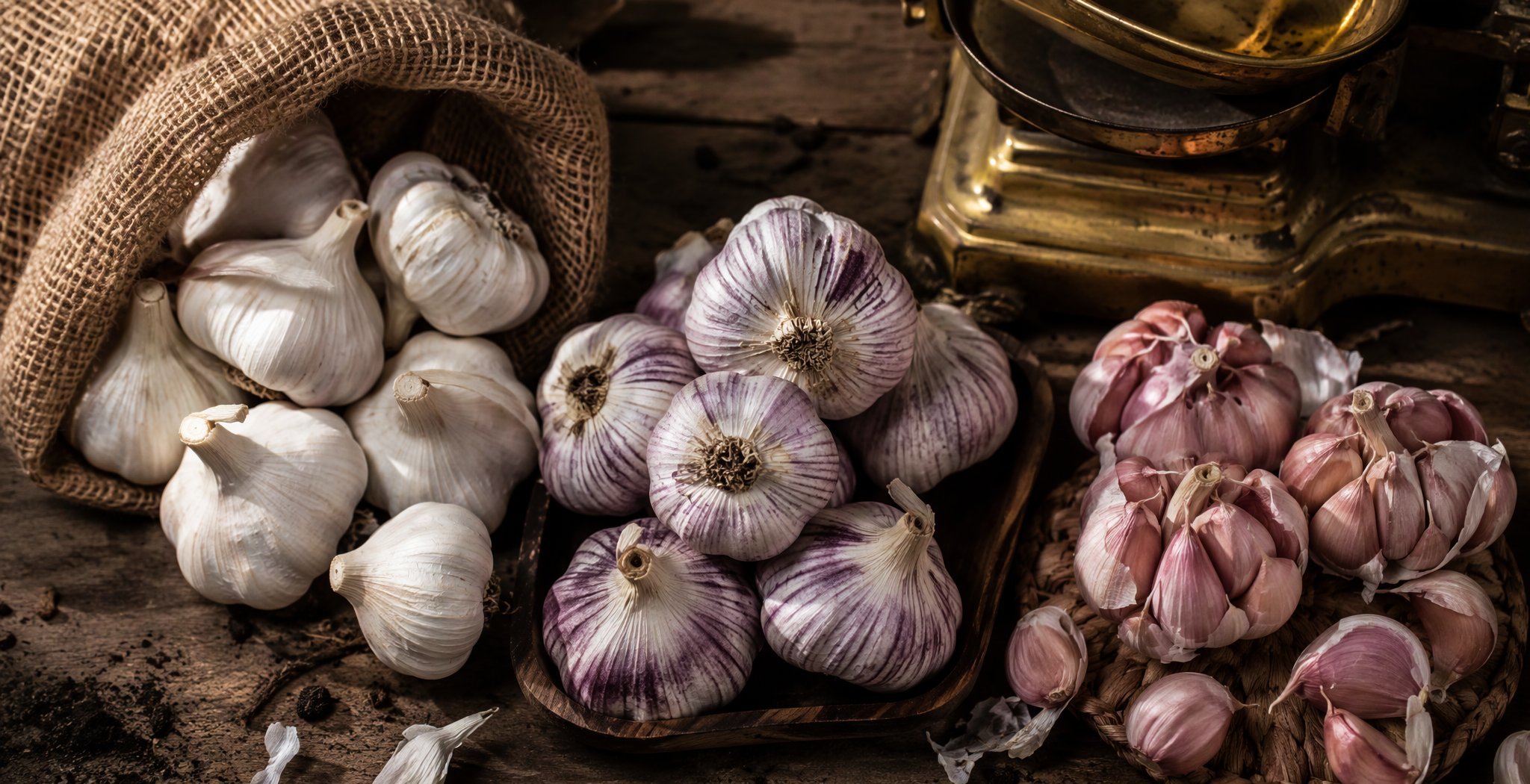
People who buy garlic often say: garlic from Shandong Province, China is sharp and pungent, garlic from Yunnan Province, China is clean and crisp, and garlic from Kastamonu, Turkey is rich and mellow. Is this just foodie mysticism, or verifiable science? The answer leans far more toward the latter than you might think — over the past five years, multiple research teams in formally published papers have "weighed" garlic from different regions again and again using GC-MS, elemental analysis and metabolomics, and the conclusion is clear: regional flavor differences are not only real, they are quantifiable and distinguishable on chemical profiles. For buyers sourcing garlic oil raw materials, the knowledge in this article has a very practical use: telling the difference between "peak shape differences" and "adulteration signals".
The chemical foundation of flavor: an "enzymolysis–cleavage" chain reaction
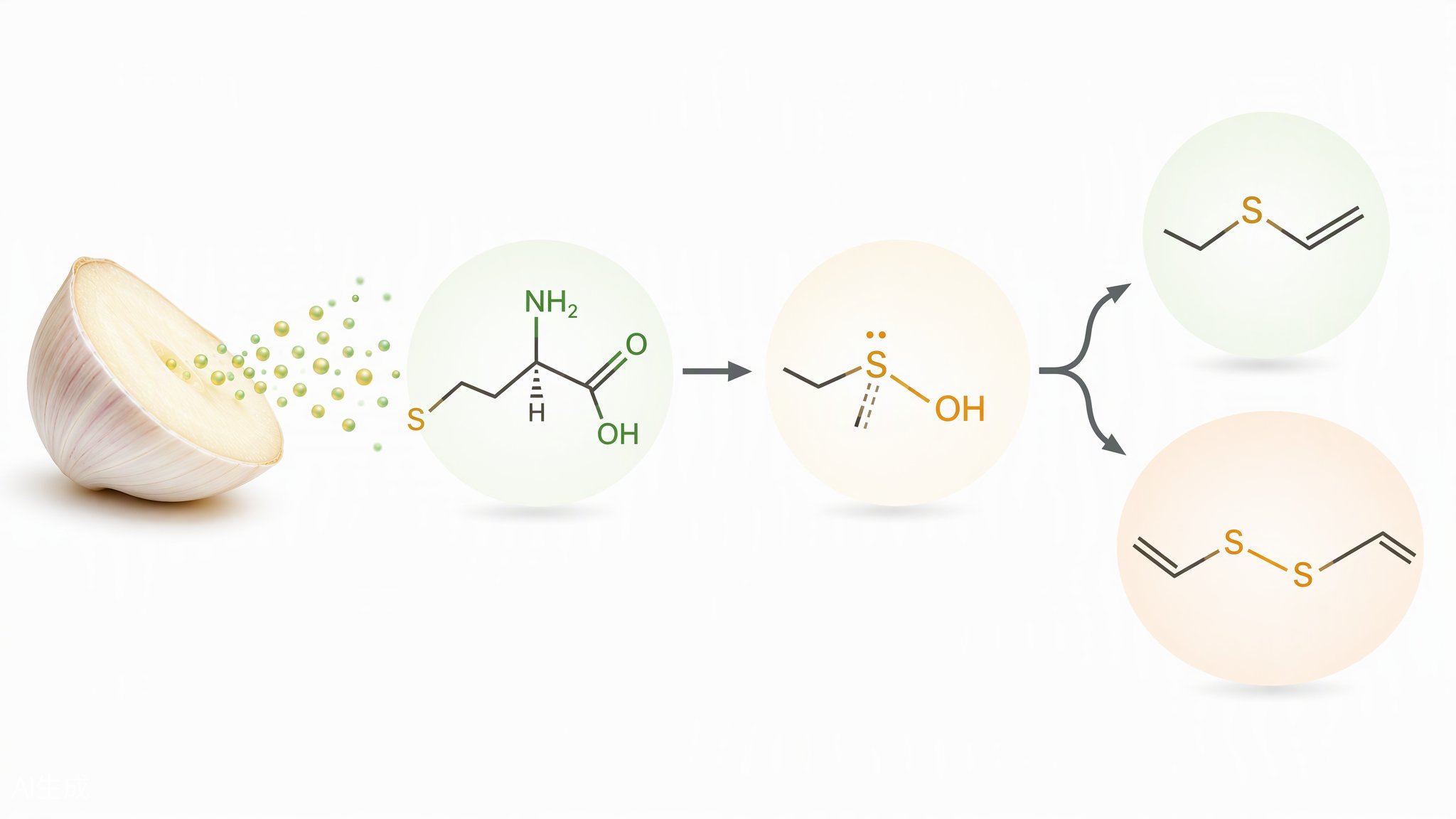
Intact garlic cloves are barely pungent at all. The sharp bite and garlic aroma are "detonated" only after tissue is damaged: alliin and alliinase in the cells are stored in separate compartments, and the moment a clove is cut or crushed, the enzyme immediately catalyzes the cleavage of alliin, producing highly unstable allicin, which then quickly breaks down into more stable small sulfur-containing molecules — diallyl disulfide (DADS), diallyl trisulfide (DATS, trade name garlicin), and others. These are the real source of the pungent aroma and the layered aftertaste.
This chain explains why regional differences can be captured by instruments: the total amount and proportion of sulfur-containing compounds are the core variables behind flavor differences, while soil elements, altitude, and day-night temperature differences change the final proportions by affecting the accumulation of alliin precursors; variety genetics set the upper limit of basal alliin content and enzyme activity. In other words, "one soil, one garlic" holds true at the molecular level — flavor is written jointly by genes and environment.
Domestic production regions: a flavor map tested and measured by research
The origins below are not selected by reputation; they come from formally published studies on garlic geographical origin identification — a team from Hebei Agricultural University compared garlic from four Chinese regions, and another team covered purple-skinned garlic from five major garlic-producing provinces in China.
Jinxiang County, Shandong Province, China (Jining samples)
Sandy loam soil on the Huang-Huai Plain, China; tight cloves and high baseline levels of sulfur compounds. In origin identification studies, the Jining group formed a distinguishable chemical profile from the other three regions. Garlic exports from Jinxiang have long ranked among the top in China, making it a major source region for most garlic oil raw materials.
Qixian County, Henan Province, China (Kaifeng samples)
Eastern Henan Plain (eastern Henan Province, China); a high proportion of purple-stripe garlic. The Kaifeng group was identified as an independent origin category at both the elemental and volatile levels.
Dali, Yunnan Province, China (highland samples)
Cool climate on the Yunnan plateau with large day-night temperature differences; mostly purple-skinned varieties. Studies suggest its volatile component structure differs noticeably from other low-altitude origins, with a flavor profile leaning toward clean and crisp.
Pizhou, Jiangsu Province, China, and Langfang, Hebei Province, China
Pizhou, Jiangsu Province, China is known for white garlic, with some purple-skinned cultivation in the north; Langfang, Hebei Province, China is a representative sample from the North China Plain. Related studies included these two locations in multi-origin comparisons, and their metabolite profiles can be separated from Shandong and Henan samples.
There is also an "invisible variable": differences between varieties from the same origin (purple-skinned/white-skinned/single-clove garlic, i.e., purple-stripe garlic, white garlic, single-clove garlic) can sometimes be larger than differences between origins. Strictly speaking, the two variables "origin" and "variety" are often intertwined — which is why studies must identify both origin and variety simultaneously.
The profiles speak: where the differences land
In the study on garlic from four Chinese regions, a total of 34 chemical elements, 68 volatile substances and 854 metabolites were detected, from which 10 elements, 6 volatiles and 225 metabolites were screened as candidate markers for origin separation. Different instruments look at different sides of garlic:
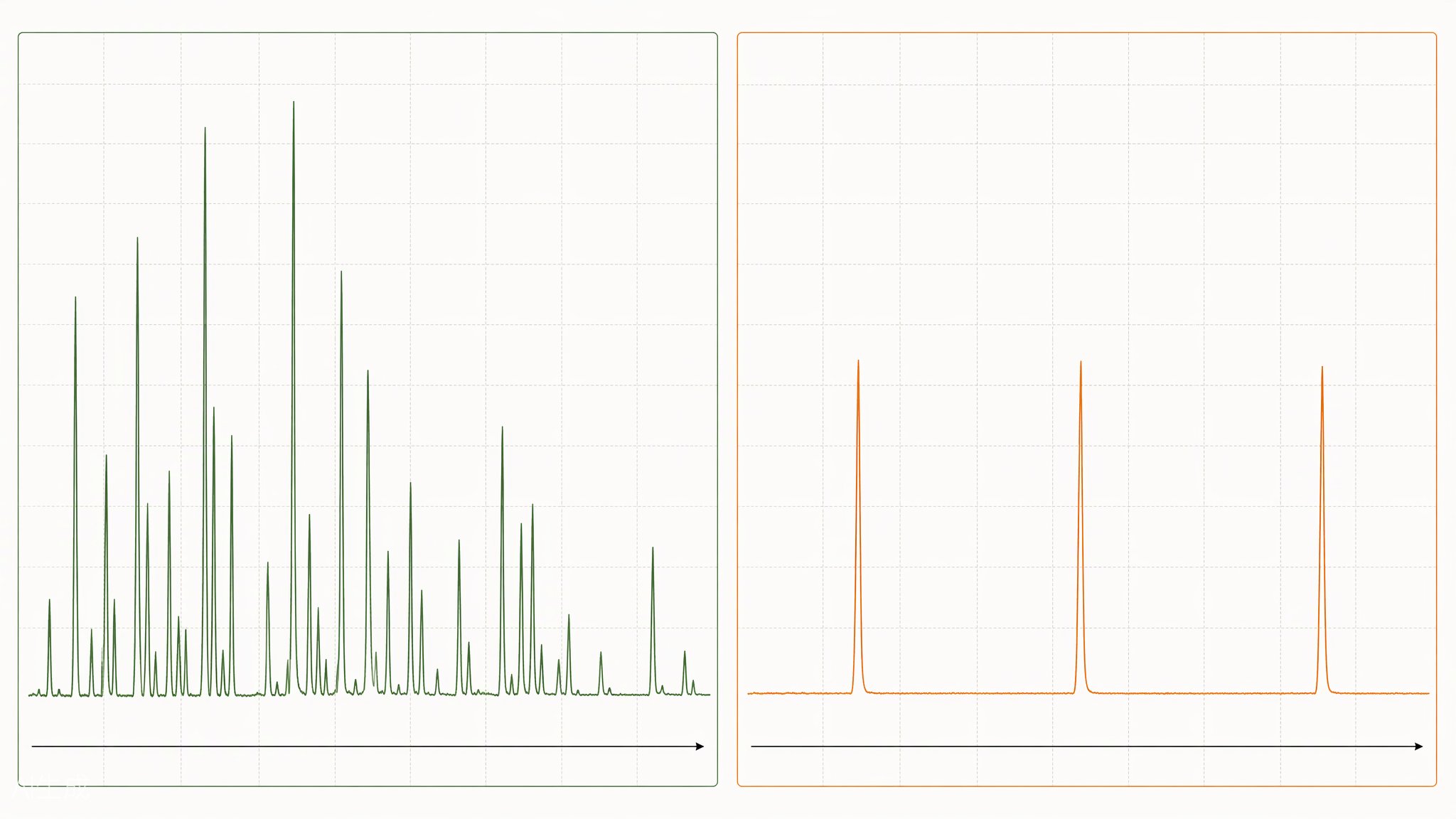
- GC-MS (aroma channel): looks at volatile sulfur compounds, which determine the pungent aroma that you "smell and taste". On a total ion chromatogram, besides the shared major peaks, peaks unique to certain regions are often the strongest discriminant evidence.
- LC-MS (metabolism channel): looks at non-volatile small molecules (organic acids, sugars, polyphenols), which determine aftertaste and layering.
- HPLC (quantitation channel): per Chinese agricultural industry standard NY/T 3871-2021, alliin content is accurately measured by external standard method at 214 nm, with a detection limit as low as 0.012 g/kg and recovery rates of 82%–98%.
- Spectroscopy (rapid channel): UV/IR does not break up samples; it relies on key absorption bands combined with machine learning to rapidly identify origin — in a multi-source data fusion study, origin discrimination accuracy using UV spectroscopy combined with an SVM model reached 100% (within the limited sample set).
Why use chemometrics instead of "taking a bite"? Because human taste can only give rough judgments of "spicy/sweet/aromatic" and cannot produce reproducible numbers. Instruments output signals across hundreds of dimensions; when PCA and PLS-DA compress high-dimensional data down to two or three dimensions, you can see samples from different origins clustering into separate groups — which is how researchers screen for real "candidate markers".
Are the data good enough to "recognize home"?
Feeding profile data into machine learning models allows testing whether "origin differences are significant enough". In a study of 200 purple-skinned garlic samples from five major garlic-producing provinces in China, after metabolomics data were processed by an LSTM model, the test-set discrimination accuracy reached 100%, and 12 differential metabolites involving 6 metabolic pathways were screened out; another medicinal quality evaluation covering garlic from 11 origins showed that 3 principal components could cumulatively explain 81.1% of quality information, with alliin content carrying the highest influence weight.
But please understand these numbers correctly: this is the discrimination performance within a defined sample set, with sample sizes on the order of dozens to two hundred. This is sufficient to support methodological conclusions, but it does not mean that "garlic from any source can be 100% identified to its origin". Flavor is also affected by year, harvest period, storage conditions and cultivation methods — batches from the same origin also vary. Accuracy has boundaries of applicability; this is the dividing line between scientific expression and marketing copy.
Going abroad: three overseas regions "named" by instruments
Kastamonu, Turkey
An HS-GC/MS study directly comparing it with "Chinese imported garlic" showed: 16 aroma components were detected in Kastamonu garlic versus 20 in Chinese garlic; however, the former had richer sulfur compounds — the main component diallyl disulfide accounted for 41.87%, compared with 34.95% in Chinese samples. The strongest discriminant point was this: diallyl trisulfide was detected only in Turkish Kastamonu garlic — a single unique peak separates the two sides.
Taşköprü, Turkey
White garlic that received EU PGI (Protected Geographical Indication) certification in 2021; cloves are wrapped in pale pink skin with pale creamy yellow flesh. Reports claim its selenium content can be up to 136% higher than garlic from other Turkish regions, with a strong, pungent flavor and a slight bitterness, suitable for heavy dishes such as roasted meats and stews.
Piacenza white garlic, Italy
A multi-omics study published in 2025 measured both its volatile and non-volatile compounds: 89 volatile compounds and over 2300 non-volatile compounds were identified, with notably high accumulation of aldehydes, and the flavor was described by researchers as "fresh" rather than pungent. This exactly illustrates that regional differences are not only reflected in being "spicier" or "more intense" — they can also be reflected in flavor direction itself.
What this means for garlic oil purchasing
This is the most useful section for buyers in the whole article. Returning to daily business: for what is all called garlic oil, GC-MS chromatograms of different batches often do not match perfectly in peak shape and peak-area ratios. In the previous article "Allyl Chloride: The Synthetic Fingerprint That Cannot Be Hidden in a Drop of Garlic Oil", we discussed that the key to judging adulteration is "whether there are substances that should not be there" — so how should you read "slight differences in expected peaks"?
Combined with the data in this article, the answer is clear: batch-to-batch variation in natural fingerprints is normal, not an alarm. The origin, variety, harvest season and storage duration of raw garlic all shift the relative heights of peaks on the chromatogram; as long as no abnormal compounds (such as allyl chloride, a synthetic process fingerprint) are present, and the proportions of major components fall within reasonable ranges, the differences are more likely from origin and variety factors. Conversely, if every batch of oil from a supplier has an identical, immaculate chromatogram with nothing beyond the main peaks, it is worth asking an extra question — the fingerprints of natural raw materials should carry the "accent" of their soil and water.
Therefore, a robust acceptance approach combines three checks: GC-MS fingerprinting to look at chromatogram shape and abnormal compounds (this is where adulteration signals appear), carbon-14 verification to check whether the carbon source is modern plant-based (principle explained in "Carbon-14 Testing: From Cosmic Rays to Natural Origin Proof"), and cross-checking document authenticity against the three elements of a qualified COA — batch number, method and results. If you have requirements regarding origin itself, "origin fingerprint + elemental analysis" is already a mature path validated by academia — which is why we provide origin information support for buyers in the traceability process.
Rigorous note: where these numbers come from
An article about science must state the sources and boundaries of its data. The main studies cited in this article include: a combined multi-element + volatilomics + metabolomics discrimination study of garlic from four Chinese regions published by a team from Hebei Agricultural University in Food Control (2021); a metabolomics and machine learning geographical origin traceability study of 200 purple-skinned garlic samples from five major production provinces published in *Science and Technology of Food Industry* (China, 2024); a dissertation on garlic origin traceability using multi-source spectral data fusion; a comparative study of volatiles between Kastamonu and Chinese garlic (PMC); a multi-omics study of Piacenza white garlic (PMC, 2025); and Chinese agricultural industry standard NY/T 3871-2021 *Determination of alliin in garlic — High-performance liquid chromatography*. Three points need to be re-emphasized: sample sizes are limited, accuracy figures are "within-sample-set" results, and flavor is also affected by year and cultivation conditions — when citing these numbers, please refer to the original literature.
Closing words
The same species (Allium sativum), given a different soil and a different day-night temperature swing, gets its flavor rewritten — this is a masterpiece co-authored by land and genes, and also science visible on instrument profiles. For buyers, understanding this layer of chemistry adds a layer of judgment: you will neither miss real adulteration signals, nor misjudge a natural regional accent as a quality defect.
If you would like to learn about the origin information of our garlic oil products, or request samples with batch-numbered COA and third-party test reports, please contact us for a quote — we typically reply within 24 hours, with a minimum order of 1 kg.
Frequently Asked Questions
Do Jinxiang garlic and Yunnan garlic really taste different?
Yes, research data support this. Multiple published origin identification studies show that garlic from regions in China such as Shandong (Jinxiang/Jining), Henan (Qixian/Kaifeng) and Yunnan (Dali) can be clearly distinguished by instruments in terms of volatile sulfur compound composition, element content and metabolite profiles. Garlic from Yunnan highland regions is typically described as leaning toward clean and crisp, while Shandong garlic is known for high baseline sulfur compounds and a strong, pungent aroma.
Which is spicier, purple-skinned garlic or white-skinned garlic?
The general rule is that purple-skinned garlic is more pungent with a higher baseline alliin content, while white-skinned garlic is relatively milder — but this is not absolute. Studies show that the variables of variety and origin are often intertwined; when the same variety is grown in different regions, sulfur compound content also varies noticeably, so you cannot judge spiciness by skin color alone while ignoring origin.
The GC-MS chromatogram of a garlic oil batch looks different from last time — is it adulterated?
Not necessarily. The fingerprint of natural garlic oil shows batch-to-batch variation with raw material origin, variety, harvest season and storage conditions; this is normal. The key to judging adulteration is "whether there are substances that should not be present" (such as allyl chloride residues from synthetic processes), not "whether the relative peak heights are perfectly identical". Only when abnormal compounds are detected or carbon-14 results are abnormal should it be handled under adulteration procedures.
How do you verify the raw material origin of a batch of garlic oil?
The path validated by academia is "origin fingerprint + chemometrics": use GC-MS to look at volatile component fingerprints, use elemental analysis to look at soil-source characteristics, and then apply models such as PCA/PLS-DA for discrimination. It should be noted that this type of discrimination has sample boundaries and is suitable as supporting evidence rather than absolute certification; for purchasing decisions, cross-checking it with carbon-14 testing and batch-numbered COA is the most reliable approach.